Why Tier 2 & Tier 3 Cities are Becoming Climate-Tech Innovation Hotspots in India

Sumita Singh
August 14, 2026
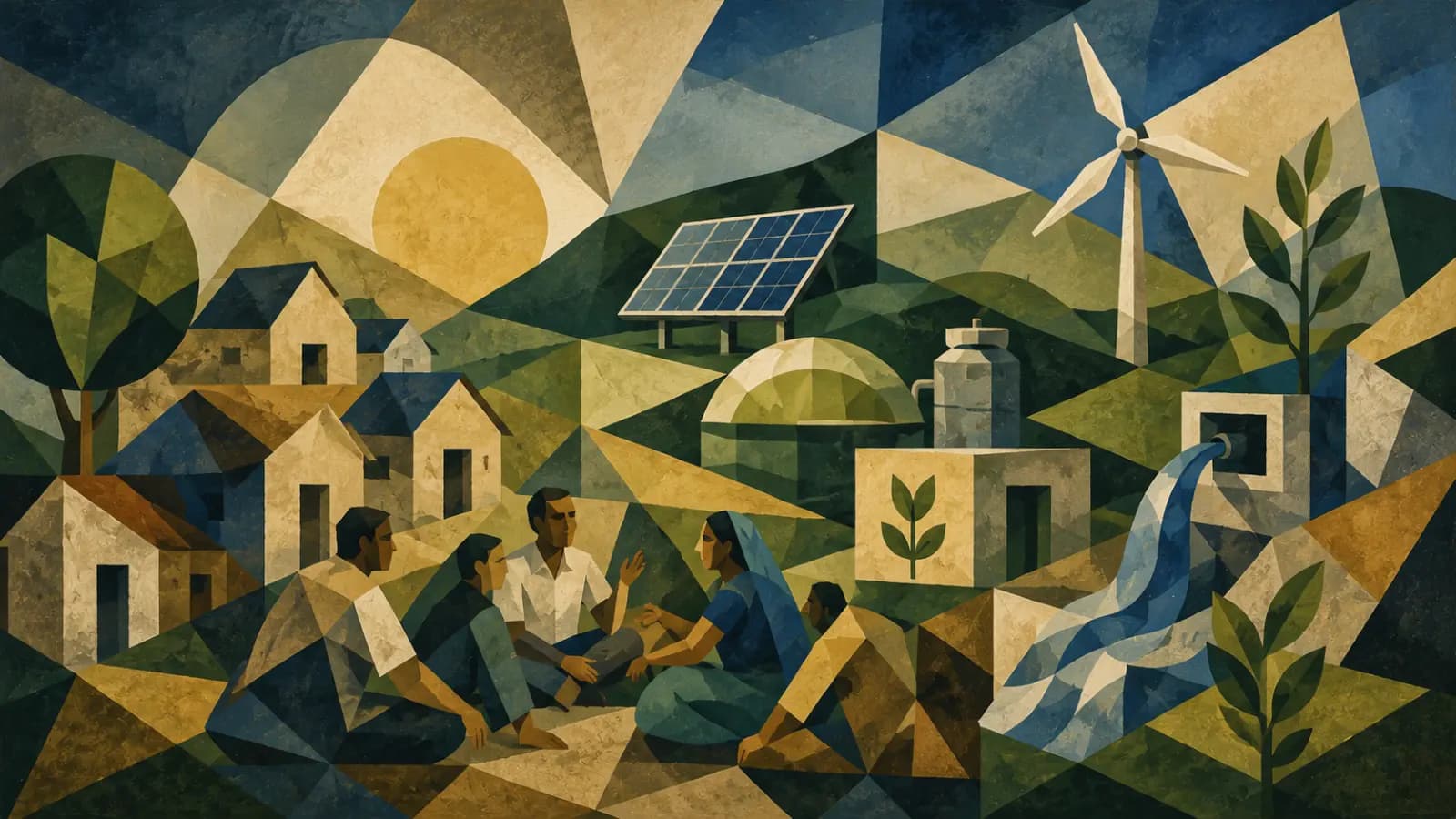
For years, the story of Indian innovation had one setting: the glass towers, coffee shops, and tech parks of Bengaluru, Delhi-NCR, Chennai and Mumbai. If you were building anything ambitious, and especially anything climate-related, the assumption was that you needed to be there, close to the capital, the incubators, and the networking circuit.
The data no longer supports that assumption.
Data Behind India’s Tier 2 and Tier 3 Climate-Tech Boom
A PIB (Press Information Bureau, Government of India) report published January 2026, marking ten years of the Startup India initiative, puts hard numbers on this. India has over 2 lakh (200,000+) DPIIT-recognized startups as of December 2025, and around 50% of these startups originate from Tier-2 and Tier-3 cities. More than 45% have at least one woman director or partner. The report explicitly frames this as “the democratization of entrepreneurship,” and notes that government schemes like GENESIS (MeitY) and NIDHI-iTBI (Department of Science and Technology) are now deliberately targeting Tier-2/3 cities for deep-tech and inclusive incubation – government schemes are actively steering this shift, not just riding it.
Climate-tech is tracking the same curve, arguably faster. Data from the Greenr Sustainability Accelerator, run by TechnoServe with backing from the IKEA Foundation and Visa Foundation, published in December 2025, found that across three cohorts of green enterprises spanning 106 cities in 28 states, nearly 45% of the startups it supported came from Tier-2 and Tier-3 cities. Strikingly, 60% of these enterprises were working on waste management – e-waste, wastewater, plastics recycling, and green construction materials from agri-waste – not as an afterthought, but as their core business. 60% of the supported enterprises were women-led, and the cities driving this – Jaipur, Bhubaneshwar, Surat, Indore, Coimbatore, Kochi, Guwahati, Madurai, Dehradun, Bhopal – are a long way from the traditional VC map.
The capital is starting to follow. A Tracxn report published in June 2026 puts India’s cumulative climate-tech equity funding at roughly $12.8 billion across 1,583 startups and 2,770 rounds since 2020, with annual funding climbing from around $315 million in 2020 to $2.6 billion in 2025. Renewable energy leads the pack at $1.5 billion raised, but the spread across other categories is telling: solid waste management has secured $477 million, energy efficiency tech $352 million, air pollution management $237 million, and water and wastewater management $208 million – segments where Tier-2/3, feedstock-adjacent ventures are disproportionately represented.
The usual explanation for this migration is cost. Commercial real estate and operating costs in Tier-2 cities run 30-40% cheaper than in Tier-1 metros, and policy pushes – from the Department for Promotion of Industry and Internal Trade (DPIIT) recognition drives to industrial corridor investment to the Carbon Credit Trading Scheme going live in October 2026 – have made it easier to build outside the traditional hubs. Both of these are real and worth acknowledging, but for climate-tech specifically, they’re not the whole story.
Why Climate-Tech Innovation Follows the Problem, Not the Capital City
Climate-tech has to live somewhere physical. You can’t decarbonize a supply chain, sequester carbon in soil, or convert crop residue into fuel from a co-working space in Koramangala. The raw material of the solution – the waste stream, the degraded soil, the water stress, the diesel-dependent farm – is physically located somewhere. Increasingly, that somewhere is a Tier-2 or Tier-3 town.

This shows up clearly in Project SAFFAL‘s own 2025 cohort of women-led SMEs. These aren’t metro founders solving problems in the abstract; they are building where the feedstock and the need are.
- Svabag Labs (Anantapur, Andhra Pradesh) is building decentralized, off-grid renewable energy networks for rural and semi-urban communities, because that’s where the energy gap actually is.
- In Kashmir, apple pomace and Azolla weed pile up as agricultural waste with nowhere to go, polluting local water bodies; Farooqii Animal Feeds turns that waste into low-cost livestock feed, developed in partnership with agriculture universities in Kashmir and Jammu.
- Tekari Agro Producer Company (Bihar) has built climate-resilient mushroom huts and waste-to-wealth composting models, integrating mushrooms, baby corn, and dragon fruit farming into a single women-led agri-enterprise across Bihar’s farming belt.
- Tribal women in remote pockets of Odisha have long cultivated medicinal and aromatic plants using climate-resilient methods rooted in local knowledge – a supply chain that simply doesn’t exist near a metro. Konkuwan Herbs, based in Baseli Sahi, Puri, builds directly on that existing practice rather than importing one.
None of these ventures could relocate to Bengaluru and keep functioning. Their innovation is their location.
“India’s climate-tech founders aren’t choosing Tier 2 and Tier 3 cities for cheaper rent – they’re building where the waste, the water stress, and the problem itself already exist. Their innovation is their location.”
Beyond Lower Costs: Why Climate-Tech Startups Are Choosing Small Towns Over Metros
The cost argument is true, but it undersells what’s happening. If Tier-2/3 growth were only about cheaper real estate, you’d expect climate-tech founders to cluster in secondary cities close to existing supply chains and consumer markets – the Jaipurs, Punes, and Indores – already booming with fintech and SaaS talent.
Instead, a large share of climate-tech founders are going further still – into small towns and rural clusters that don’t show up on any startup-hub list, because that’s where the agricultural waste, the water stress, and the underserved livelihoods actually sit. This is decentralization of a different kind – founders chasing the geography of the problem, not just cheaper square footage.
What Decentralized Climate Innovation Means for Climate Finance
If innovation is decentralizing, but capital access hasn’t caught up, that’s a structural gap – and it’s exactly the gap Project SAFFAL is built to close. Traditional climate finance infrastructure is still calibrated for metro-based, VC-track startups: pitch decks, term sheets, and networks that assume proximity to Mumbai or Bengaluru. A women-led enterprise turning banana stem waste into biodegradable products in a Tier-3 town in Bihar, or a Kashmir-based agri-feed startup working with two regional universities, doesn’t fit that mould, and shouldn’t have to.
Facilities like SAFFAL exist precisely to meet founders where they are, rather than waiting for them to migrate toward capital. SAFFAL isn’t a goodwill gesture toward smaller towns. It’s a bet that decentralized innovation needs decentralized finance behind it.
Climate-Tech Innovation Across South Asia: Nepal, Bangladesh, and Sri Lanka
The wider pattern doesn’t hold as cleanly across the rest of South Asia, and it’s worth being honest about that.
Bangladesh’s startup funding is heavily concentrated in Dhaka, which accounted for roughly 70% of activity in H1 2025, with Chittagong a distant second at 16% and every other city in single digits. Industry analysts there describe the ecosystem as still built around a narrow, well-connected circle based in the capital.
Sri Lanka’s own researchers list geographic concentration in Colombo as one of the structural constraints holding back its startup ecosystem, alongside limited early-stage capital and weak rural infrastructure. Neither country shows India’s Tier-2/3 decentralization at the ecosystem level, at least not yet.
Nepal comes closer: funding has grown ten-fold since 2020, and Kathmandu is increasingly described as “no longer the only hub,” with Pokhara, Biratnagar, and Butwal building active founder communities of their own.
What’s consistent, though, is the instinct at the level of individual founders – even in ecosystems still centred on the capital.
Sparsa, a Nepal-based venture, turns banana stem waste into compostable menstrual pads through a rural, women-led production model that couldn’t function from Kathmandu. VermiCow Organics runs black soldier fly farming and vermicomposting operations that depend on proximity to organic waste streams, not city infrastructure. In Sri Lanka, Releaf‘s community carbon blueprint model is based in the Eastern Province, deliberately outside Colombo. In Bhutan, Black Mountain Green Tea‘s organic tea cultivation is based in Trongsa, in the country’s central highlands, not Thimphu.
These ventures are outliers relative to their national ecosystems, not evidence of a regional trend, but they show the same underlying logic as India’s Tier-2/3 founders: when the raw material of the problem sits outside the capital, so does the innovation, whether or not the surrounding ecosystem has caught up yet.
The Future of Climate-Tech Innovation Is Decentralized
The next decade of Indian – and South Asian – climate-tech will not be won in glass towers. It will be built in Anantapur, Koraput, Tekari, and a hundred towns like them, by founders solving the problems in front of them with whatever the local landscape provides. The question for investors, policymakers, and finance facilities isn’t whether this decentralization will continue. It’s whether the infrastructure to fund it will catch up in time.
Join SAFFAL
The Climate Finance Catalyst for South Asia
Apply as an Impact Philanthropist, Donor, Startup, SME, Climate Expert, or Institution. Mobilize climate capital into the right sectors.