What is Biochar? How Farm Waste Becomes a Climate Solution

Sumita Singh
August 20, 2026
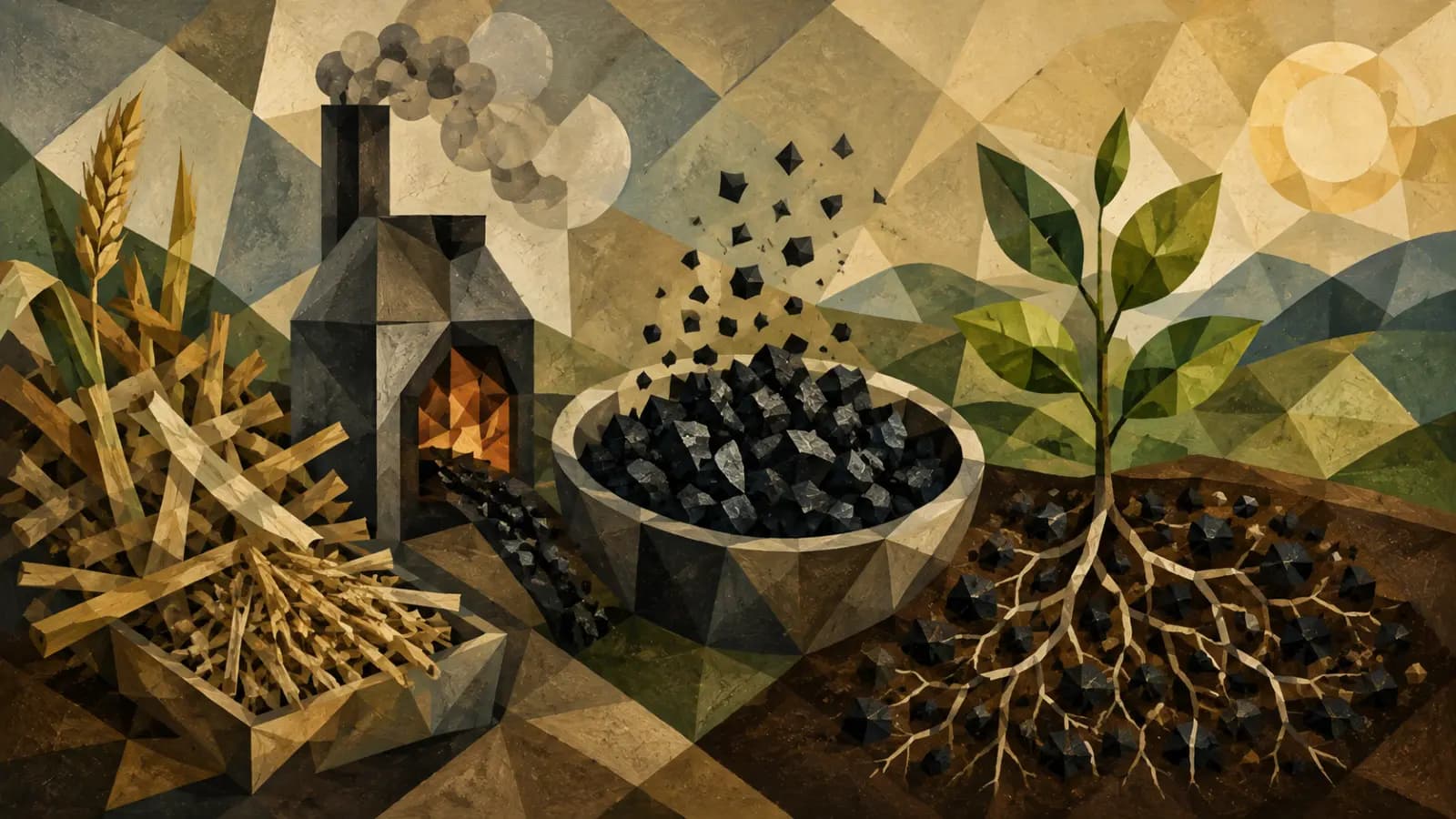
India generates roughly 500 million tonnes of crop residue every year. About 100 million tonnes of it is burned in open fields – releasing carbon, choking cities in smog, and wasting what could be a valuable climate asset. There’s a low-tech way to turn that waste into a multi-decade carbon sink instead: it’s called BIOCHAR.
What Exactly Is Biochar?
Biochar is a stable, carbon-rich material made by heating organic waste – crop residue, wood chips, manure, or even municipal green waste – in a low-oxygen environment. This process, called pyrolysis, breaks the material down without fully combusting it, leaving behind a charcoal-like substance that looks like what you’d find in a barbecue, but functions very differently once it enters the soil.
Unlike raw biomass, which decomposes and releases most of its carbon back into the air within a few years, biochar locks carbon into a solid, stable form that can remain in the ground for hundreds to thousands of years. That single property is what makes it such a compelling climate tool.
How Biochar Sequesters Carbon: The Pyrolysis Process Explained
When farm waste decomposes naturally or is burned, the carbon stored in it during photosynthesis is released back into the atmosphere as CO2 (or worse, as methane in some conditions). Pyrolysis interrupts this cycle. By heating biomass at temperatures typically between 300°C to 700°C with limited oxygen, the process converts unstable carbon into a highly stable, aromatic carbon structure that resists microbial breakdown.
The scale of this potential is significant: applying biochar to just 10% of the world’s agricultural land could sequester approximately one gigaton of CO2 per year. To put that in perspective, one gigaton of CO2 is roughly equivalent to taking about 215 million cars off the road for a year – more than every car currently registered in India. More recent independent assessments put the global mitigation potential even higher, in the range of 2.6 to 10.3 billion tonnes of CO2 equivalent per year.
No complex machinery, no unproven technology – just controlled heat applied to something farms already produce in abundance.
Benefits of Biochar for Climate Change and Soil Health
Biochar’s appeal lies in the fact that it solves several problems at once:
1. It reduces greenhouse gas emissions. Instead of burning residue in the open (a major contributor to particulate air pollution and short-term climate forcers like black carbon), converting it to biochar avoids those emissions altogether while locking away the carbon that would have been released.
2. It improves soil health. Biochar has a highly porous structure, giving it a large surface area that helps soil retain water and nutrients. The effect is measurable: a large meta-analysis of 111 field trials found little effect on crop yield in temperate regions, but an average 25% increase in tropical regions, where most of South Asia’s farmland sits.
3. It creates a productive use for agricultural waste. Crop residue stops being a disposal headache and starts being an input – a seasonal liability turned into a marketable product.
4. It’s measurable and durable. Because biochar’s carbon is chemically stable, it’s one of the few nature-based carbon removal methods that can be reasonably quantified and verified, making it attractive for carbon credit markets and climate finance mechanisms.
Biochar Limitations: Cost, Scalability, and Quality Challenges
Biochar isn’t without real debate, though. Global estimates of its mitigation potential vary enormously – from as little as 0.03 to as much as 11 gigatons of CO2 equivalent per year – depending on assumptions about biomass availability and technology. Cost is another open question: independent estimates put the underlying cost of biochar-based carbon removal at $18–$166 per tonne, considerably more than avoided-deforestation credits, though current market credit prices run higher (see below).
And not all biochar is equal; quality and carbon stability depend heavily on feedstock and pyrolysis conditions, meaning outcomes can differ significantly between a smallholder’s kiln and an industrial reactor. It’s why serious climate finance treats biochar as promising but still-maturing, with real limits worth tracking.
Biochar Carbon Credit Prices: Cost Per Tonne of CO2 in 2026
For a sector increasingly funded through blended finance and climate finance, the numbers matter as much as the science. Physical biochar sells for $400-$1,200 per tonne, depending on the grade, application, and regional market, but the more relevant figure for climate-finance stakeholders is the carbon credit it generates: in 2025-2026, biochar carbon removal credits have traded at $125-$200 per tonne of CO2, clustering around $150-$170 – up roughly 25% from 2023, as corporate buyers like Microsoft and Stripe lock in multi-year offtake agreements.
South Asia has a distinct cost advantage. Indian biochar is among the cheapest credits available globally. Artisanal, community-scale projects price around €105 per tonne, while industrial-scale Indian biochar trades at €120-€150, well below comparable European projects (which push toward €200). For women-led SMEs entering this space, that’s a real edge: it means Indian and South Asian producers can be price-competitive in a market that’s still supply-constrained, with demand currently outpacing delivered volumes.
“Indian biochar is emerging as one of the cheapest carbon removal credits in the world – a real edge for the ventures building it.”
Biochar Production Process: From Crop Residue to Carbon Sink
The basic process is simple enough to be adapted at different scales:
- Feedstock Collection: Crop residue, husks, stalks, or other biomass is gathered after harvest.
- Pyrolysis: The biomass is loaded into a kiln or reactor and heated in a low-oxygen chamber, converting it into biochar, along with byproducts like bio-oil and syngas that can sometimes be captured for energy use.
- Processing: The resulting biochar is cooled, sometimes crushed or granulated, and occasionally enriched with nutrients (a process known as “charging”) before use.
- Application: Farmers apply it directly to soil, mix it into compost, or use it in animal bedding and water filtration systems.

Technologies range from small, low-cost kilns designed for smallholder farmers to industrial-scale pyrolysis units that can process large volumes of agricultural or forestry waste.
Biochar in South Asia: Crop Residue Burning and Carbon Removal Startups
As noted earlier, South Asia sits at the centre of this problem. India’s crop-burning crisis doesn’t stay within its borders: pollutants travel with prevailing winds and affect air quality across Pakistan, Nepal, and Bangladesh too. The health impact downwind is severe: when rice farmers in northwestern India burn their fields, PM2.5 concentrations in Delhi – hundreds of kilometres away – have been found to spike to roughly 20 times the WHO’s safe air threshold.
A growing number of clean energy and climate-tech ventures are turning this residue into biochar for soil amendment, filtration, and even construction materials – sitting at the intersection of climate mitigation, air quality, and rural livelihoods that climate finance increasingly looks to support.
KriSHE Carbon, a climate-tech venture in Gujarat, India, ran a pilot between January and March 2025 that trained 500 women farmers to convert cotton stubble into biochar using low-cost kilns. In just three months, the initiative produced over 21 tonnes of biochar, applied it across all 501 participating farms, and sequestered roughly 40 tonnes of CO2, while stopping residue burning entirely in the participating communities.
Farmers, who now earn an extra income operating a kiln, are pleased with both the income and the sense of ownership it brings. KriSHE Carbon aims to scale to 10,000 women farmers and 15,000 tonnes of CO2 sequestered by 2026-27, a decentralized model built on the idea that India’s carbon opportunity lives in a million small villages, not one large plant.
A similar model is emerging in Nepal. Aptech Lab, a Global Resilience Partnership-backed venture in the Hindu Kush Himalaya region, is running “The Biochar Project in Nepal” converting agricultural waste into biochar while channelling carbon-finance income specifically to women farmers.
As these decentralized, women-led ventures mature across South Asia, they’re beginning to show that carbon markets can be built around smallholder farmers rather than bypassing them.
Is Biochar the Future of Carbon Removal? Final Takeaways
Biochar is one of the few climate solutions that works with existing agricultural systems, not against them, though it’s far from a silver bullet. It takes a problem – farm waste with nowhere to go – and turns it into a tool for carbon removal, soil restoration, and cleaner air, all without requiring farmers to change what they grow.
The uncertainty around its exact mitigation potential and cost is real, but it’s the kind of uncertainty that shrinks as more ventures like KriSHE Carbon and Aptech Lab generate ground-level data – not a reason to wait on the sidelines. As climate finance mechanisms mature and carbon markets get more sophisticated about measuring durable carbon removal, biochar is positioned to move from a niche practice to a mainstream part of the climate toolkit.
Join SAFFAL
The Climate Finance Catalyst for South Asia
Apply as an Impact Philanthropist, Donor, Startup, SME, Climate Expert, or Institution. Mobilize climate capital into the right sectors.