Renewable Energy in South Asia: A Country-by-Country Guide to Clean Power

Sumita Singh
August 21, 2026
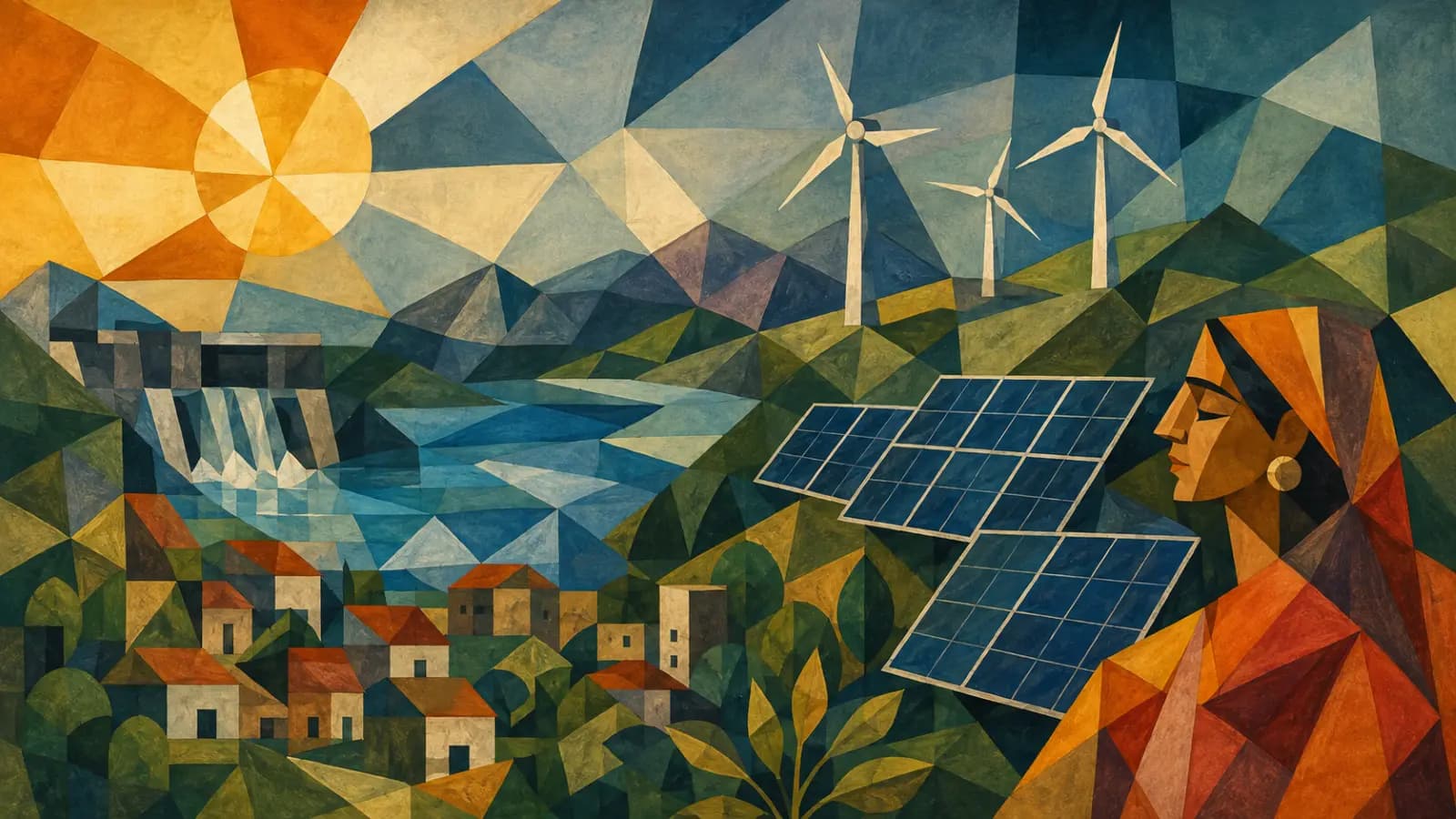
Renewable energy in South Asia isn’t one story – it’s actually eight similar – yet different – stories. Home to more than a fifth of the world’s population, the region spans everything from a Himalayan kingdom that’s actually carbon negative, to an island nation converting one atoll at a time from diesel generators to solar hybrids.
Some countries here get almost all their electricity from rivers; others are betting their entire clean energy future on rooftop and utility-scale solar. What ties them together is the direction of travel: every country in South Asia is moving toward cleaner power, just starting from very different points and moving at very different speeds.
This overview breaks down where each of the eight SAARC countries – India, Pakistan, Bangladesh, Sri Lanka, Nepal, Bhutan, Maldives, and Afghanistan – actually stands today: what powers their grids right now, what’s changing fastest, and a few numbers along the way that might surprise you.

If you’ve ever wondered what the “most important source of renewable energy in South Asia” really is, the honest answer is that it depends entirely on which country you’re standing in – and that’s exactly what makes this region worth understanding one country at a time, and not as a collective.
India’s Renewable Energy Boom: Solar Leads 288 GW Capacity
Fast Fact: In 2025 alone, India added more solar power capacity than most countries have installed in their entire history.
India’s total installed renewable capacity, including hydropower, reached 288 GW by mid-2026 – 52% of the country’s total power capacity – after adding 30.6 GW in the first half of 2026 alone, a 25% year-on-year increase. Solar led that growth, with additions up 43% to 26.34 GW, building on nearly 50 GW of solar commissioned in 2025. The scale of that shift is genuinely global-first: In 2025, India installed more new solar capacity than the United States did, for the first time ever.
This growth has made India the region’s undisputed anchor for solar-led expansion, and the government isn’t slowing down, with a target of 500 GW of renewable capacity by 2030.
Pakistan’s Renewable Energy Mix: Hydropower, Solar and Wind
Fast Fact: The World Bank had calculated that solar panels covering just 0.071% of Pakistan’s land area, a sliver smaller than many of its cities, could meet the country’s entire electricity demand.
Few people realize how quickly Pakistan’s power mix is changing. Solar and wind together now supply 22% of the country’s electricity, according to Ember‘s latest tracking, while hydropower contributes roughly another quarter – pushing clean electricity to 55% of the total mix. Fossil fuels now make up the remaining 45%. Much of that solar growth has come from an unusually fast, largely unsubsidized rooftop and distributed solar boom rather than utility-scale projects. Pakistan’s official target is more ambitious than it might sound: 60% renewable electricity (combining non-hydro renewables and large hydropower) by 2030, and the government says it’s already running ahead of its earlier interim milestones.
Bangladesh’s Renewable Energy: World’s Largest Off-Grid Solar Program
Fast Fact: Bangladesh runs the largest off-grid solar program on Earth; bigger than any single national rooftop-solar scheme in Europe or North America.
Bangladesh’s renewable energy capacity stands at roughly 1,559 MW, with solar making up about 81% of that (1,265 MW), followed by hydro at 230 MW and wind at 63 MW. Renewables are still a small share of the total grid, but Bangladesh built one of the world’s largest off-grid solar programs, extending electricity access to roughly 20 million people through distributed solar home systems – a model now studied and replicated by governments across Africa and Southeast Asia.
Nepal’s Hydropower: South Asia’s Renewable Energy Powerhouse
Fast Fact: Nepal has an estimated 84,000 MW of hydropower potential locked in its rivers but has so far tapped less than 5% of it.
Nepal’s total electricity capacity reached 4,200 MW as of April 2026, still overwhelmingly hydropower-led. But the project pipeline tells a different story: Of the 54 new power purchase agreements signed in fiscal year 2025/26, 49 were solar projects (675 MW) versus just 5 hydropower projects (28.6 MW) – a sign solar is starting to close the gap even though hydro still dominates installed capacity. Nepal’s 2025 climate targets aim for 14 GW of clean energy by 2030. The country’s older seasonal pattern hasn’t gone away, though. Nepal remains self-sufficient in electricity through the monsoon but still imports power from India every winter.

Bhutan’s Renewable Energy: World’s Only Carbon-Negative Country
Fast Fact: Bhutan’s forests absorb roughly four times more CO₂ than the entire country emits, making it one of the only carbon-negative countries on Earth. Its constitution legally requires at least 60% forest cover, forever.
Hydropower supplies more than 90% of Bhutan’s energy and doubles as its biggest export: the country sells surplus electricity to neighbouring countries, mainly India, offsetting millions of additional tons of regional carbon emissions each year. The country is now actively diversifying: the Asian Development Bank recently approved a $160 million loan to add at least 310 MW of new solar capacity, supporting Bhutan’s first private-majority public-private partnership in the power sector – a deliberate hedge against the glacier-melt and rainfall risks that could destabilize hydropower as the climate changes.
“Bhutan’s forests absorb roughly four times more CO₂ than the entire country emits – making it one of the only carbon-negative countries on Earth.”
Sri Lanka’s Renewable Energy: 70% Clean Electricity and Rising
Fast Fact: Sri Lanka once ran its entire grid on hydropower alone, before diversifying into wind and solar, it was a single-source system not unlike Nepal or Bhutan today.
Sri Lanka has since moved furthest of any South Asian country from that single-source dependency. Renewable sources – hydro, wind, and a rapidly growing solar sector – have reached close to 70% of electricity generation, putting the country within sight of its own 2030 target of 70% renewable generation. The push has real economic stakes: Sri Lanka’s 2022 crisis was driven partly by the cost of importing fuel for power, making energy self-sufficiency a matter of financial stability as much as climate policy. Wind is carrying much of the recent momentum – the 20 MW Windscape Mannar wind farm went live in January 2026, and a larger 50 MW project broke ground the following month, both part of an ADB-backed push to make Mannar the country’s renewable energy hub. If that pipeline holds, Sri Lanka could be the first South Asian country to actually hit its own 2030 renewable target on schedule.
Afghanistan’s Renewable Energy Potential: 300,000 MW Untapped
Fast Fact: Afghanistan’s untapped renewable potential – over 300,000 MW across hydro, solar, wind, and geothermal – dwarfs its current generation many times over.
Domestic generation remains minimal: as of mid-2026, Afghanistan produces only around 250 MW domestically and imports roughly 800 MW from Uzbekistan, Tajikistan, Turkmenistan, and Iran – meaning imports cover roughly 80% of the country’s electricity. Hydropower supplies most of what’s generated domestically, at around 77%. In July 2026, the Taliban administration approved a five-year power development plan covering 25 new generation projects across hydro, solar, wind, and coal, alongside already-signed contracts for 17 plants totaling 1,820 MW – though officials say the country needs 6,000-7,000 MW to meet full domestic demand.
Maldives Renewable Energy: From Diesel Dependence to Solar Islands
Fast Fact: The Maldivian government has announced plans to make Vaadhoo – one island in Raa Atoll – the country’s first fully solar-powered inhabited island, with the project already about a third of the way there.
The Maldives has depended almost entirely on imported diesel – until recently. Renewable capacity’s share has grown from under 1% in 2012 to almost 24% in 2026. A 6.4 MW solar hybrid system inaugurated across 25 islands in Raa and Baa atolls in July 2026 is expected to generate 10.4 GWh of clean electricity annually, save over 3 million litres of diesel a year, and cut CO2 emissions by roughly 8,400 metric tons annually – pushing the country’s total renewable capacity to 116 MW. It’s part of a national push toward a 33% renewable electricity target by 2028.
What’s the Most Important Renewable Energy Source in South Asia?
As is evident from the data above, two things hold true almost everywhere: hydropower remains the backbone wherever geography allows it (Nepal, Bhutan, and to a lesser extent Afghanistan), and solar is now the fastest-growing technology in every single country on this list, often scaling faster than grid infrastructure can absorb it. The countries furthest along – Sri Lanka, India, and increasingly the Maldives – are the ones treating renewables as a diversified portfolio rather than betting on one technology. And in almost every case, the biggest constraint isn’t resource availability, its financing, grid capacity, and getting power to the people who need it most.
“The biggest constraint isn’t resource availability; it’s financing, grid capacity, and getting power to the people who need it most.”
How SAFFAL is Financing South Asia’s Renewable Energy Transition
That last point – financing the last-mile delivery – is exactly the gap Project SAFFAL (South Asia Finance Facility for Acceleration and Leverage) works in, closing the funding gap for the women-led SMEs actually building the infrastructure behind these national numbers. A few examples from the current SAFFAL cohort:
- Svabag Labs (India) – decentralized, cooperative off-grid solar networks for rural and semi-urban communities
- Sunbridge Solar Nepal – hybrid solar-battery water pumping and household electrification systems
- Xeltra Energy (Bangladesh) – solar-powered EV charging and battery-swapping infrastructure
- Bio Lanka Global (Sri Lanka) – solar-powered modular homes and solar irrigation systems
- Women Light the World (Nepal) – training women as solar engineers to deliver last-mile microgrids
These ventures are proof that the real bottleneck across South Asia’s clean energy transition was never resource availability, it’s making sure capital reaches the people already building the solutions. That, in the end, is the more interesting statistic: not how much renewable capacity a country has, but who’s able to build it.
Join SAFFAL
The Climate Finance Catalyst for South Asia
Apply as an Impact Philanthropist, Donor, Startup, SME, Climate Expert, or Institution. Mobilize climate capital into the right sectors.