What is Regenerative Agriculture, and How is it Different from Organic Farming?

Sumita Singh
August 18, 2026
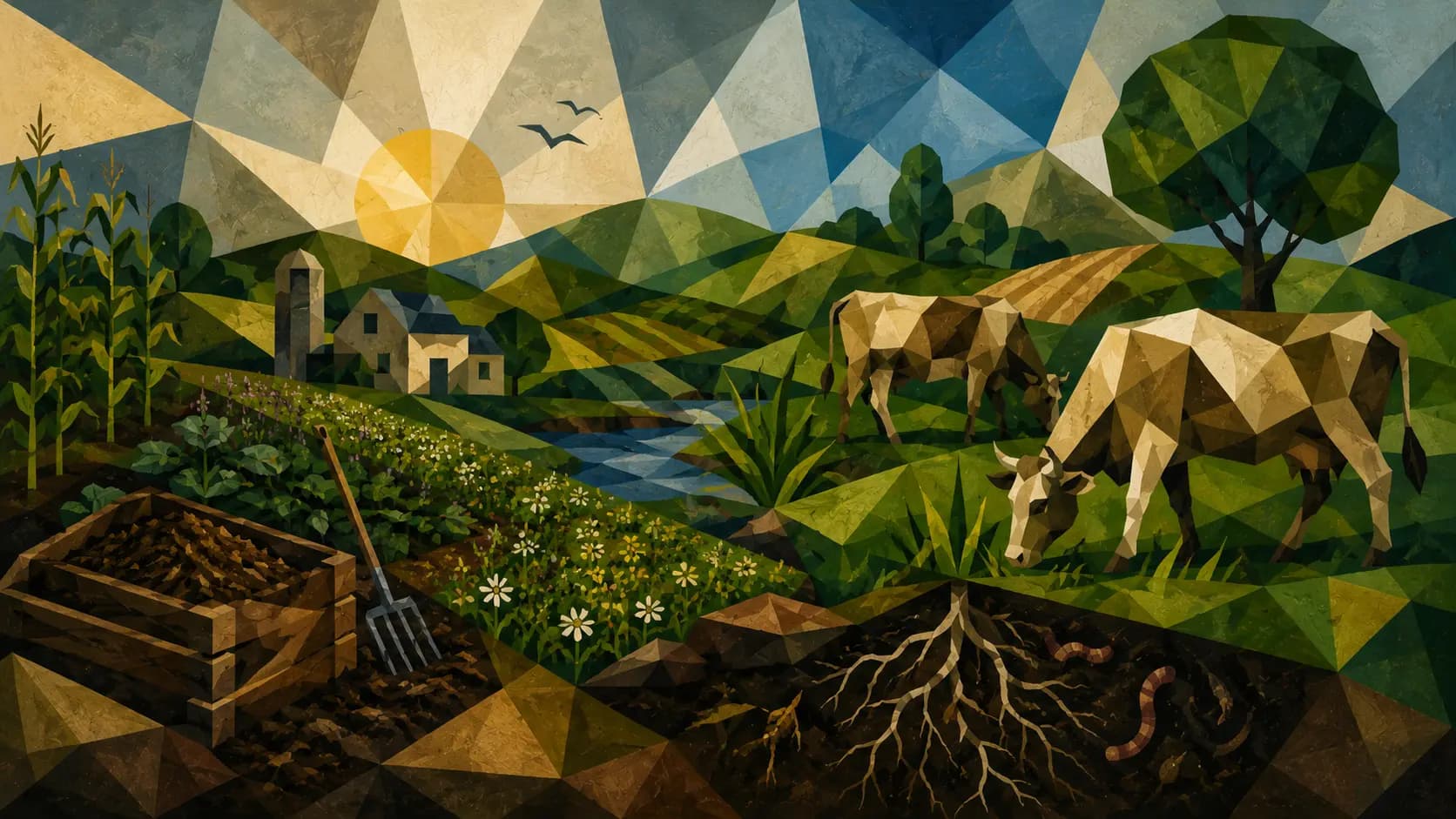
Let’s picture two neighbouring farms. Both are certified organic – no synthetic pesticides, no chemical fertilizers, no GMOs. One has been tilled every season for a decade, growing the same crop in the same soil. The other hasn’t seen a plough in years; its soil is dark, spongy, and alive with earthworms and fungal networks. Both wear the same “organic” label. However, only one of them is actually getting healthier.
That gap – between avoiding harm and actively restoring life – is the difference between organic farming and regenerative agriculture. It’s a distinction that matters more than ever. Climate finance institutions, impact investors, and agri-startups are increasingly being asked to prove real environmental outcomes, not just good intentions, before capital moves. That means understanding which problem a venture is actually solving.
Producing food without synthetic inputs protects farmworkers and consumers from chemical exposure and reduces pollution running off into rivers and groundwater – a real and necessary goal. But it does nothing, on its own, to reverse the decades of damage industrial farming has already done to the soil itself: the loss of organic matter, the collapse of microbial life, and the erosion that leaves land less able to hold water or withstand drought. That second problem – rebuilding what’s already been degraded – requires a fundamentally different set of practices, and it’s the one regenerative agriculture is specifically designed to address.
What is Soil Organic Matter, and Why has it been Disappearing?
Before comparing organic and regenerative approaches, it helps to understand what’s actually at stake beneath the surface: organic matter itself.
Soil organic matter is any material in the soil that comes from plant, animal, or microbial life in various stages of decay – decomposing roots, crop residue, manure, and the remains of dead microorganisms, broken down over time by the soil’s own biological activity. It typically makes up only a small portion of soil, usually 1% to 6% by weight, but it punches far above its weight – acting as the main driver of soil fertility, structure, and water-holding capacity. Soil Organic Carbon (SOC), the carbon-based component within organic matter, is commonly used as its measurable proxy, since carbon accounts for roughly half of organic matter’s total mass.
That small percentage has been shrinking for decades. In India, government data shared by the National Rainfed Area Authority (NRAA) shows soil organic carbon content has fallen from around 1% seventy years ago to about 0.3% today, a decline attributed largely to intensive cultivation without adequate organic replenishment, heavy dependence on chemical fertilizers, and the burning of crop residue instead of returning it to the soil.
The effects of this decline compound on each other:
- Falling fertility and yields – soils need increasingly higher doses of synthetic fertilizer just to sustain the same output.
- Weaker soil structure – depleted soils are more prone to crusting, compaction, and erosion.
- Lower water retention – carbon-poor soils dry out faster, leaving crops more exposed to drought stress.
- Collapsing microbial life – the microorganisms that cycle nutrients for plants struggle to survive without organic matter to feed on.
- Rising costs and dependency – farmers get pulled into a cycle of ever-higher fertilizer use that masks the underlying soil problem rather than solving it.
This is exactly the gap regenerative agriculture is built to close – not just avoiding new synthetic inputs but actively rebuilding the organic matter that decades of intensive farming have stripped away. But let’s understand organic farming and regenerative agriculture first.
What is Organic Farming? Definition, Practices, and Limitations
Organic farming is, at its core, a rulebook. It defines what farmers cannot use: synthetic pesticides, chemical fertilizers, genetically modified seeds, and growth hormones. In most countries, “organic” is a certified, regulated label – farmers must follow specific standards and pass several inspections to market their produce as organic.
The goal is to reduce chemical exposure – for the land, for farmworkers, and for consumers. Organic methods often include crop rotation, composting, and biological pest control. It’s a meaningful step away from industrial agriculture’s heaviest chemical dependencies.
Organic farming has real global scale: nearly 99 million hectares of agricultural land worldwide are now managed organically, across almost 190 countries, with global retail sales of organic food surpassing €136 billion in 2023. India alone counts over 2.3 million organic producers – more than any other country.
But here’s the catch: organic certification doesn’t automatically restore soil health. A field can be certified organic and still be tilled repeatedly, planted with a single crop year after year, and left bare between seasons – all practices that degrade soil structure and biodiversity over time. Organic tells you what’s absent from a farm. It doesn’t necessarily tell you whether the land is getting healthier.
What is Regenerative Agriculture? Principles, Practices, and Living Soil Benefits
Regenerative agriculture starts from a different question: not “what should we remove?” but “how do we make the land more alive than before?” The term itself was coined by Robert Rodale, son of organic-farming pioneer J.I. Rodale, who wanted to describe something that went beyond merely “sustainable”. His Rodale Institute has argued that regenerative farming works by leaning into ecosystems’ own tendency to heal themselves once given the chance.
In practice, this looks like a core set of interlocking habits rather than a fixed checklist:
- Minimal or no tillage, to protect soil structure and the fungal networks within it.
- Cover cropping, keeping the soil covered and roots in the ground year-round.
- Diverse crop rotations, instead of monocultures.
- Integrating livestock, where animals graze and naturally fertilize the land.
- Composting and organic matter building, to feed soil microbiology rather than just the plant.

The measurable goal is regeneration: increasing soil organic matter, drawing down atmospheric carbon into the ground, improving water retention, and rebuilding biodiversity above and below the surface. Done well, regenerative farms can turn degraded land into a net carbon sink.
Crucially, regenerative agriculture has no single global certification standard (though several, like Regenerative Organic Certified (ROC), regenagri, and the Rainforest Alliance Regenerative Agriculture Standard, are emerging). It’s judged more by outcomes – soil carbon levels, water infiltration rates, biodiversity indices – than by a fixed list of banned substances.
The evidence for these outcomes is growing. A 2025 meta-analysis of 147 peer-reviewed studies across India’s agro-ecological zones found that regenerative practices – including farmyard manure, green manure, compost, biochar, and conservation tillage – increased soil organic carbon by roughly 17% over baseline levels, with the gains growing stronger the longer the practices were sustained.
A separate global review of 345 soil carbon measurements across seven regenerative practices found that every single practice examined – from cover cropping to no-till to non-chemical fertilizer use – measurably increased carbon sequestration rates, with the effect often amplified when practices were combined.
“Organic farming asks: what are we keeping out?
Regenerative agriculture asks: what are we building back?“
It also pays off financially – eventually. A BCG analysis of regenerative transitions in wheat farming found that while farmers often see a temporary dip in profits during the first couple of years of transition, they went on to see profitability rise 70-120% higher than conventional farming once the new system stabilized, with a projected return on investment of 15-25% over ten years.
Regenerative Agriculture in Action: Examples from Project SAFFAL
This isn’t just a theoretical distinction; it’s already showing up in the businesses that took part in Project SAFFAL cohort.
Crop Domain, an India-based startup, is building a soil-and-farming venture that turns organic waste into natural farming inputs – biofertilizers, decomposers, and biopesticides – to help crops grow better while making food healthier and reducing environmental harm. That’s regenerative thinking in action: instead of just avoiding synthetic inputs, the startup is actively working to rebuild soil biology, precisely the “add life back” approach that separates regeneration from simple avoidance.
Working in Bangladesh’s coastal farmlands, Agrochar takes a different route to the same goal. The startup converts agricultural waste into designer biochar – a soil amendment that combats salinity and fertility loss while restoring soil biology and improving water retention. This lines up neatly with the research: biochar was identified as the single highest-performing regenerative practice for soil carbon gains in the India meta-analysis cited above, making Agrochar’s approach a strong real-world match for what the science says works.
Regenerative Agriculture Vs. Organic Farming: Key Differences Explained
| Organic Farming | Regenerative Agriculture | |
| Primary Focus | Avoiding synthetic chemicals | Restoring soil and ecosystem health |
| Framework | Certified, rule-based standard | Outcome-based set of principles |
| Tillage | Often still practiced | Minimized or eliminated |
| Measures Success By | Compliance with input restrictions | Soil carbon, biodiversity, water cycles |
| Can Overlap With | — | Organic practices (often does) |
It’s worth noting these aren’t mutually exclusive. A farm can be both organic and regenerative – many of the most resilient farms are. But a farm can be organic without being regenerative, and, less commonly, a farm can use some regenerative practices without meeting full organic certification (for instance, if it occasionally uses a targeted synthetic input).
How to Spot Greenwashing in Regenerative Agriculture Claims
Because “regenerative” isn’t yet a legally protected term in most markets, it’s an easy word to slap on a label without much behind it. A few questions can help separate genuine practice from marketing:
- Is there a specific practice named – cover cropping, no-till, rotational grazing – or just the word “regenerative” on its own?
- Is there any outcome data — soil carbon tests, biodiversity counts – or only a claim of intent?
- Is it paired with organic certification, or does it stand entirely alone with no verifiable baseline?
- Does the company talk about duration? Real soil regeneration takes years, not one growing season – claims of instant transformation are a red flag.
- Is there third-party verification (e.g., Regenerative Organic Certified, Soil Carbon Index) or is it self-reported?
None of these alone proves or disproves legitimacy, but a startup or brand that can answer most of them with specifics is worth far more trust than one relying on the word alone.
Why Regenerative Agriculture Matters for Climate Finance and Investors
For climate-tech accelerators and impact investors, this distinction isn’t academic. Organic certification signals reduced chemical harm, which matters for consumer health and local ecosystems. Regenerative practices signal something climate finance increasingly needs to quantify: measurable carbon sequestration and long-term soil resilience against droughts, floods, and erosion – all of which are becoming more frequent and severe.
That quantification is most important because agriculture (including land-use change) is estimated to account for roughly 24% of global greenhouse gas emissions – making soil-centric solutions one of the few climate levers that can turn farmland from an emissions source into a carbon sink.
Startups building regenerative agriculture models – whether through soil microbiome products, cover-crop seed systems, agroforestry integration, or precision tools to monitor belowground ecosystem – are positioned at the intersection of food security and climate mitigation. That’s a compelling case for funders looking to back agriculture ventures with real, trackable climate impact, not just reduced-harm claims.
Regenerative Agriculture Vs. Organic Farming: The Bottom Line
Both approaches matter, and neither should be dismissed in favour of the other. But as climate pressures mount, and soils across South Asia and beyond continue to degrade under decades of intensive farming, the ability to measure and verify real outcomes – not just intentions – is what will determine which ventures earn long-term trust from funders, buyers, and the farmers themselves.
For the women-led SMEs at the heart of Project SAFFAL, this distinction is also a market opportunity: soil-health data, verified carbon outcomes, and transparent practice disclosures are increasingly what unlocks access to climate finance, carbon markets, and premium buyers who are willing to pay for proof, not just promises. As more capital flows toward nature-based climate solutions, the startups that can clearly show – not just claim – what they’re building back into the land will be the ones best positioned to scale.
Join SAFFAL
The Climate Finance Catalyst for South Asia
Apply as an Impact Philanthropist, Donor, Startup, SME, Climate Expert, or Institution. Mobilize climate capital into the right sectors.